Frequently Asked Questions
What is the best way to launch WDA’s progressive disciple building strategy?
- Consider Joining WDA for an Online or In person Introductory Seminar.
- Get a copy of Disciple Building: A Biblical Framework and read individually or with a group of leaders.
- Begin to Do Ministry in Groups or as a Life Coach
- A small group can begin using the Cornerstone (Phase I-II) resources.
- A Life Coach can meet with a few disciples and develop individual projects based on the “NGP” approach.
- An outreach team can implement the School of Ministry (Equipping for Ministry -Phase III) format.
- Sometimes a Restoring Your Heart group will be the best entry point for helping people grow.
- Start Training Leaders using the Leadership Institute IV-A series to develop new leaders as they begin to disciple others.
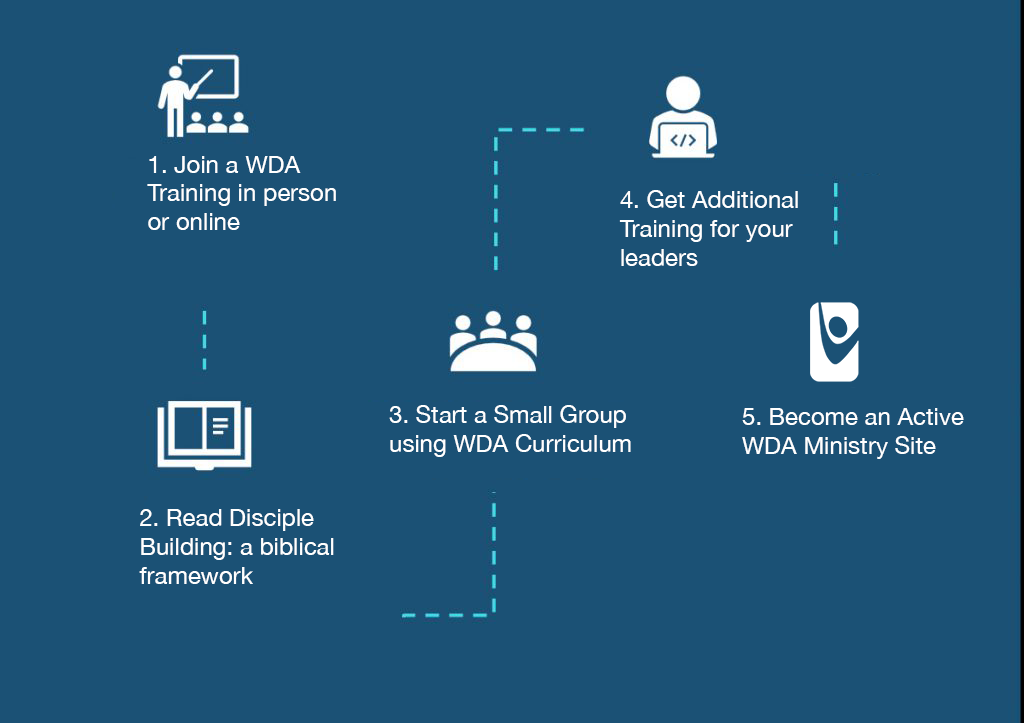
Although there is no “best way”, it is important that ministry leaders agree on a few matters before using the resources and training:
- Helping people grow to maturity is important, but it’s not easy or simple. Spiritual warfare is always part of the process. Pray and be prepared for opposition.
- Be sure your key leaders agree on the approach offered by WDA before you begin. Have everyone read and discuss Disciple Building: A Biblical Framework
- Aim low (at least at first). If your ministry has well-established traditions, it’s probably best to begin with a limited scope. A small group of new or young believers and / or people who want to strengthen their spiritual foundation is a good setting for the Laying Foundations (Phase II) resources. If your ministry has a need for outreach, you might want to challenge some of your more mature members to join an School of Ministry – Equipping for Ministry (Phase III) Ministry Team. (Be sure to use the Christian Growth Checklist (CGC) to help determine if this is the appropriate situation.)
- Go slowly. New skills and approaches take time to understand and implement. Don’t be in a hurry. The goal is maturity, NOT a discipleship program.
- Remember, though patterns and principles exist, every situation (like every believer) is unique. Use the training and resources, but look to and depend on the Holy Spirit to guide you.
What is the best setting for spiritual growth: a community group, a Life Coach (mentor) relationship, a study group, a lecture-sermon, personal retreats or active ministry engagement(s)?
Actually, all of these settings facilitate spiritual growth and all are necessary. But to be most effective, they must be integrated and balanced. Understanding the dynamics of the progressive growth process and correctly accessing the needs and maturity of a disciple can help a disciple builder determine the best strategy and approach.
What happens after Cornerstone (Laying Foundations – Phase II)?
Ideally, all the people who go through the Cornerstone Academy (Phases I-II) will be ready to begin the School of Ministry (Equipping for Ministry – Phase III). In reality, not everyone will be ready for Ministry Training. Some will need more time to learn and apply the truths of the Laying Foundations Experience. Other people may have emotional and relational problems that keep them from moving forward spiritually.
We need to help those who are not ready to move on in their growth assess where they are and develop a plan to deal appropriately with the issues in their lives. It is the responsibility of the Life Coach (or small group leader) to help the person decide what the next step will be for him. The resource Life Coaching Manual (WDA) will help the mentor with this task.
The person may need to repeat some portions of Cornerstone (Laying Foundations Experience – Phase II), or he may need to be in a community group that encourages his growth while he deals with other issues that are slowing him down. If the issues are particularly troublesome he may need to be in a recovery group. (Refer to How Emotional Problems Develop, WDA for a further discussion of this.)
What happens after Equipping for Ministry (Phase III)?
Some disciples are ready to be challenged for a leadership role (Developing New Leaders: Phase IV). But not everyone who participates in a phase is automatically ready for the next phase of development. Several factors affect the timing:
- The ability of a disciple to assimilate and apply truth. Not everyone grows at the same rate. It’s a fact. Don’t rush the process. The goal is maturity, not covering material. Encourage those who are ready to move on to join the Phase IV Leadership Group. Encourage those who are not ready, to participate in a small group. We stress the importance of community groups that exist alongside the progressive training process (See Small Groups Manual, WDA).
- Life Circumstances. Sometimes jobs, health concerns, family responsibilities, even other church roles prevent a disciple from moving ahead. Make sure the reason for delay is legitimate. (Remember the admonition of Jesus to leave things behind for the sake of following Him.)
- The need for emotional healing. Sometimes the disciple building process reveals emotional damage. Encourage some people to join a recovery small group and continue the process of healing before moving ahead.
What if my leaders are not equipped to disciple?
In the early years of WDA most of us on staff had never been equipped to disciple even though we were in an organization that focused on building disciples. We learned as we did it. As our disciples learned and grew, we learned and grew. Although it may not be ideal, your leaders can do the same, and God will be faithful to bless their commitment and diligence. The materials that are available from WDA will be helpful.
What about those who get “stuck” and are unable to go forward spiritually?
Although in some cases there may be a specific, known problem that a person must address before he can move forward spiritually, usually the person does not know what is preventing him from growing. Whichever is the case, the Life Coaching Manual will help you isolate areas that need attention and develop a plan to address those areas. If there are complex emotional and relational issues involved, the person may need to be a part of a recovery group or need to receive personal counseling or both. (See How Emotional Problems Develop, WDA.)
What do I do about older Christians with gaps in their spiritual understanding?
Many people have gaps in their spiritual understanding because few, if any, have been discipled in a systematic way that intentionally and progressively teaches them everything they need. Because of this situation, we designed an evaluation tool called the Christian Growth Checklist. It will help you determine where a person is along the growth continuum and will also identify areas of need. By using the Life Coaching Manual (which includes instructions for the Christian Growth Checklist) you will be able to design projects to fill in the gaps you identify.
Why is following a progressive format so important to WDA?
As we studied Christ’s training of His disciples we observed a progressive pattern: complex truths built on simpler truths. For example, He allowed them to get to know Him and learn foundational truth before he challenged them to learn to share their faith. (We have all witnessed the damaging results that sometimes occur when an excited new believer is thrust into the spotlight to share his faith and is given spiritual responsibility too soon. This is the result of violating the wisdom of the growth progression.)
Understanding that growth is progressive also helps us know how to give people what they need when they need it. For example, by knowing the characteristics of a person who is finishing Laying Foundations (Phase II), we can know that he is ready to be challenged to learn to share his faith, to move on to Equipping for Ministry (Phase III). This makes the disciple building process somewhat predictable.
Your discipleship process sounds too mechanical. Where is the mystery? What is the role of the Holy Spirit?
It is essential to remember that in the disciple building process God, through the Holy Spirit, causes the growth, and He often does this in mysterious, even surprising ways. But, He also commands us to take responsibility and be a part of the process. In the Great Commission we are told to “make disciples” and “to teach them to obey everything I have commanded you.” Any philosophy or system or method of making disciples that omits either God or His people is lacking. Both are essential.
In WDA we have discovered some tools that help us do our part: the five phases, NGP, R-CAPS, etc. These tools give us ways of thinking about the process of building disciples. They provide frameworks for our thoughts; give us ways to organize our ideas. In addition, and perhaps most importantly, some of these tools such as the five phases and R-CAPS reflect patterns that we see in Scripture. For a more thorough explanation see Disciple Building: A Biblical Framework, WDA.
The fact is that disciple building principles and processes will never be applied exactly the same way in any two situations. Every group that faces the challenge of building disciples needs to get on its knees and ask God, “How do we apply this in this place and time?” Whoever is leading such a ministry must rely on the power and direction of the Holy Spirit and teach all who are involved to rely on the power and direction of the Holy Spirit. We cannot carry this out by ourselves and God never intended us to. Jesus commanded us to do these things and then promised, “And surely I am with you always, to the very end of the age.” (Matthew 28:18-20)
How do you deal with different doctrinal perspectives and traditions?
This is a difficult issue that we wrestle with as we write discipleship materials because we realize that people from many different persuasions will use them. In some cases, we avoid difficulties by allowing different groups to insert their own tradition. For example, we talk about the meaning of baptism and the need for baptism, but we leave the mode of baptism and timing of baptism to each group.
There are other subjects that we feel we cannot avoid so we offer an opinion but indicate that opinions differ on the subject. And we encourage those who have a different opinion to offer theirs as well. We do not want differences in doctrine and tradition to distract us from the task of building disciples to the glory of God. We would appreciate your prayers as we continue developing materials.
Why does WDA offer so many different kinds of resources? Wouldn’t it be easier and simpler to just have a Bible Study?
It would be simpler, but the goal is not just to provide better information, the goal is to help change character and attitude. Maturity is a complex process. The resources are designed to help a disciple builder as they help someone else to grow. By integrating teaching (Teaching Outlines and Pocket Principles) with personal devotions, group interaction and practical assignments, and aligning these to a specific level of spiritual development, we increase the probability that truth will be assimilated and acted on.